I’ve said before around the ‘what is’ of Human-Centric Leadership.
But what about the why of it? Why is it so important? Why will it continue to be important?
Everyone understands that you can’t unring a bell, it’s just not possible. Even if you slam your hands on it, you’re only muffling the bell… you never really stop the sound.
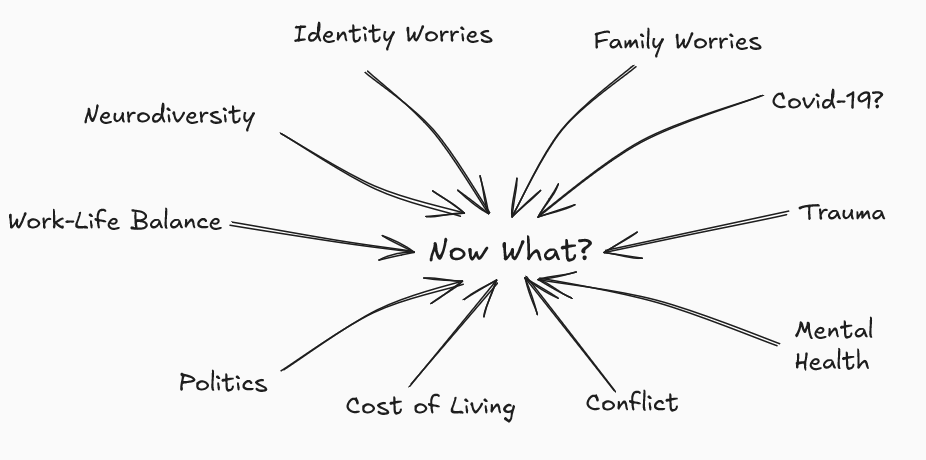
Forced metaphors aside, the past five years have been absolutely wild for the world. Covid upended just about every social construct the modern world has, We watched and were made acutely aware of broken, fragile and frankly unfair social structures that so many depend on globally. Climate Change, Rampant Capitalism, Rising inequality… So many people exploring topics they knew little about, many more spending time looking inwards and realising “Oh boy, do I have problems too?” and mental health issues started to rise. There was over a 21% increase 2019 to 2022 alone. So, Covid was clearly a fulcrum but it wasn’t the end of the problems for many.
- Wars were started, lines were drawn, politics turned toxic, basic social interactions turned aggressive…
- How do you actually lead people who are affected by these things?
- How do you even come close to showing empathy for these situations?
- How do you demand answers when leaders fail at the first hurdle?
- How do we show people they deserve better?
People started asking more of leaders, and found them wanting. A lot.
We had the Great Resignation, Anti-Work, Quiet Quitting and whatever nonsense media types liked to give showed that employees really did not give a damn about poor management. I for one welcomed it, poor leadership sucks and I’ve dealt with it all my life (bar a few shining examples.) Even better, Poor Management frequently got called out on various forms of social media, and organisations whitewashing so rarely goes well when you’ve got the back up of so many.
So a combination of rising asks for Mental Health awareness, Increasing asks on equity, diversity and the Covid-19 pandemic led to some stark asks for leaders who were unprepared for the backlash when they went “no”. Great stuff.
- Increases in action to combat workplace-related mental health issues.
- Increases in action to combat workplace-inequitability for diversity.
- Increasing financial inequality between do’ers and owners.
- Better ways of working.
- Better working hours.
- The right to switch off.
- Emotional support for <whatever>
- You name it, people need it.
They’re not exhaustive as a list, but the crux of the matter? Be better. The Meme of “People don’t leave bad businesses, they leave bad managers” is entirely true and resonates with so many people out there.
Covid might be over, but the asks are still very real from people who’ve suffered from poor management and leadership. Infact, many of the problems have gotten worse since Covid! Cost of Living crisis’s have pushed many to the absolute breaking point.
The irony is, Mental Health issues, Neurodiversity, Diversity challenges in general… they’ve always existed in one way or another. Social Media and public opinion have now brought them kicking and screaming to the front and leadership can no longer ignore it, no longer is a well-thrown pizza party enough to make people compliant. You need to act.
So a more Human-Centric approach is needed. Not even just for those who do the work, but for leaders to understand what is needed of them. Organisations will give flimsy, arse-covering advice to managers and leaders, but leaders really need to be guided on how each of us can step up and be better with individual treatment of people across an organisation.
There are so many people, each with different asks, different needs, different desires that even attempting to give a one-size fits all attitude to them just doesn’t work. Intersectionality affects absolutely everyone across an organisation.
Millenials and Gen Z are the future leaders and staff of the workplace. They’re asking for more and if current and future Leaders won’t help them? They help themselves. I’m the Millenial Leader I wished I had when I was a junior, so now it’s time for frameworks that help people, not just profits.
Because if you don’t support these people, If you fail to understand their needs, If you fundamentally don’t want to get into their shoes? You are not a leader setup for success for now and the future, and you will fail.
Next time, I’ll get into the nitty gritty of the traits of Human-Centric Leaders. I’ll start with the base-line ones, before moving onto the ones that people will notice more.
 Human-Centric Leadership