Being a Human-Centric Leader isn’t all about introspection and contemplating ones own traits. It’s also about the image that you do get across with authenticity and being genuine.
Behind closed doors, no-one can hear you scream. To many Leadership courses will focus on “Here’s how to run a good 1-2-1” or “Here’s how to have a hard conversation.” Which is fine, but it’s all the base-level stuff that happens behind closed doors (And I will talk about those at a later date!)
The things you do outside a closed room, in front of and your people? That’s the stuff that sticks. Everyone remembers the time their manager called them out in front of peers, everyone remembers when their boss roasted them for making a mistake. Everyone also remembers when they first realised you weren’t full of it when you said “I care”.
So here we go, into the active-traits that people will see as you develop into a human-centric leader;
Being Interested in People
People are amazing. They come in every shape, size, colour, creed and conundrum. They are (you are) a fantastical puzzle to develop, nurture, support and promote on as individuals. What works for one, won’t for another and you need a veritable toolbox on how to handle people and their problems. Everything from being able to laugh and joke, to understanding how to tackle hard conversations about peoples lives / disabilities / neurodiversity.
It’s never an easy task, but a natural desire to learn more about people, what they want and need, what support requirements they have, what they want from life, What their hobbies are, That desire? That’s the difference between a manager and a leader. Stepping that into your day to day? That’s the difference between a leader and a human-focused one.
It’s easy to go into work on the day to day and go black&white, but people just don’t fit into either side, so you’ve got to stick your nose in and figure them out!
Seeing Opportunities for growth
This ones always funny, because there’s three parts to it and all three are incredibly important to balance.
Your growth (as a leader) – When you step into leadership, there does come a time that you have to accept that your growth will only come if you actively seek out opportunities for yourself. Getting stuck into steering & board meetings might seem banal, but if you’ve not done these before? You need to figure out the different methods of communication, how to steer conversation, how to guide a solution from start to finish. Your own growth becomes more and more unique as you take a career path with what skills you choose to develop first. Your growth actually guides your team as you develop recruitment pipelines and work streams that open up possibilities!
Individuals in your team(s) growth (as people) – When you step into leadership, you become responsible for the development of individuals. That’s well known, but so rarely understood beyond an “End of Year” conversation. It’s easy to develop a one-size fits-all approach to developing your people. Developing a framework for people must include both introspection for them AND the opportunities you forge to get them where they want to go. If you work in the tech space? You’re going to need to figure out that People vs Individual-Contributor question. You’re going to need to develop people in directions that you can then offer them experience and work, there’s no point developing someone architecturally if you’re going to just give them analytics work!
The growth (as an organisation) – I know, human-centric leadership doesn’t feel like it should be around organisation development, right? But think of it this way. You’ve got two Seniors in your team who each want to go in different directions. If you’ve sat on a steer-co and got your point across, you’ll be pushing an agenda to develop / implement a system. This means you’re actively creating that opportunity for people.
Suddenly you get the go ahead and then you’ve got the place to put the new people and let them grow into the roles. The organisation benefits, so do they, so do you. You get your payoff, your people get their development, the Organisation gets it’s value.
It’s important to put all three together. You’re there to develop the people and the organisation. Neither succeed if the other fails, and you’re the one who has to balance the opportunistic need.
Showing vulnerability
Vulnerability can be everything from ‘empathising with someone having the worst day of their life’ through to just admitting that you don’t know enough! It’s frequently decried as ‘oversharing’ and has become a contested topic on Linkedin and by more traditional leaders in the space.
There’s a tendency of more traditional leadership styles to lean into toxic-stoic attitude towards everything. Less about emotions, more about ‘business doesn’t care about you’ approach. One that is directly being challenged by employees in the workplace post-Covid, and vulnerability supports that approach.
Oversharing is an important topic mind, breaking down in front of your teams when the going gets tough, or things are tough outside of work isn’t ideal? But it is understandable. Life’s complicated for all of us and for an incredible amount of reasons as to why as well. Seeing a leader admit that they’re going through something, admit that they need some downtime, even ask for help… It humanises people. In an era of mental health awareness? It can be a lifesaver.
I’m an avid-activist for all things Neurodiverse and Mental Health. In fact I’ve stood in front the 150+ strong department and talked about Mens Mental Health and my own troubles with it and my neurodiversity (ADHD). I’ve had 1-2-1’s with people having the worst of days, I’ve overhear tough conversations in the office and I do what humans do best? I empathise. This is the way I show my vulnerability. It’s the right way of showing vulnerability for me.
Developing it for yourself? That’s a personal journey. One that requires self-reflection and feedback from peers.
Seeking Feedback
There’s a thing called the Johari Window, it’s come into quite common parlance within Leadership communities now. But it’s history lies in psychology way back in the 50’s, and yet? It’s still a great tool.

It is essentially a way of figuring out your own internal understanding of ones self. The top right is the area that I’m going to just be a pain and focus on now (Yes, I’ll write something else about it later.)
The top right shows us that people see other things about us that we may not know. This is the area of feedback you need to focus on, but in one of lifes grand ironies you can’t exactly ask for feedback in an area that you know you’re poor at… because you’d already know.
So you have to ask quite widely what that feedback looks like. Is it forms and questionnaires to peers? To direct reports? Is it asking someone to just re-read something to pick up any biases? It shouldn’t matter. Feedback should be with whoever you’re interacting with, because that’s the widest possible remit that you’re going to get for it! Everyone can cast an opinion about you, on you, based on their views and experiences of the world. That feedback can be helpful to develop you from a fundamentally different pair of eyes in a way thst challrnges you to be better for a specific demographic (for example).
It seems such a small thing. But actively engaging with people and avoiding the facade (bottom-left) breeds an understanding and trust within teams to develop the right behaviours of being people focused!
Not to mention, this one ensures you are genuine at all times. Too much of the facade in the bottom left? You’ll never open yourself up to genuine and honest feedback. People notice and they lose faith.
Endlessly wanting to learn
In an era of Google, ChatGPT and other tools. Learning nothing day to day is almost inexcusable.
But it isn’t just about learning , it’s about developing that learning and then sharing it.
Data Engineering teams are pretty spectacular at this anyway. It’s natural for us to congregate around problems and solve them as small groups, then tell everyone how incredible we are (Only for a bug to pop up and deflate our ego). But a more formalised structure of self-guided learning for you and your people in your subject area of expertice can be invaluable.
It doesn’t mean just giving it to your reports though, it means getting certified yourself. It means stepping through the same processes and learning the same things as your people do! Sometimes to a different level, or even just enough to be lethal! (When you get so high up that you don’t code / don’t contribute that way… you may need to know enough to be lethal and surround yourself with experts!) Whilst you yourself can be an expert in certain places, you cannot be a pro in everything, you’ve got to leave space for your people to grow.
All that learning needs to be public, for all of you. Dedicated time to learn, dedicated time to educate… it’s paramount to be focused on the people of a team.
It also gives way to career frameworks and cross-functional skills matrix so everyone gets to specialise. We may all get the same job description, but we’re all a tad different!
Walking the Talk
The last post and this post above? Summed up.
If you’re claiming to be something? Then walking the talk should be easy. But if you’re full of it? You’ll get caught out quick. Authenticity is what you project, people can smell a fake a mile away.
We’ve all had poor leaders who claim to be knowledgeable/empathetic/understanding/good and they turn out to be the polar opposite quickly when stress hits them. This one is simple, it’s not doing that. It’s following through with what you say you are.
Which is easy? Right?
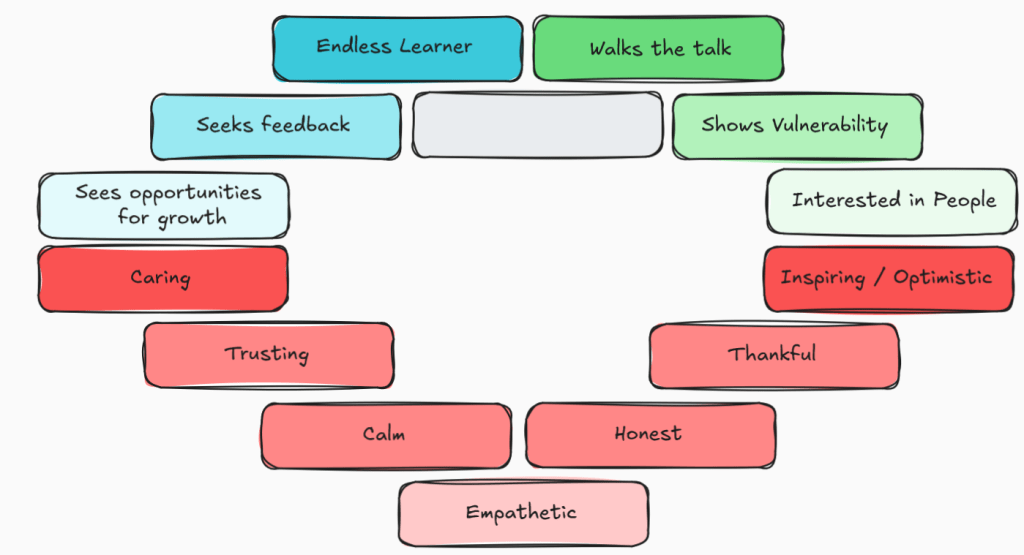
These are the behaviours that your teams will see in you. These are the behaviours they will value in seeing and getting support from. These are the behaviours that will define you as human-centric, focused on your people and getting them the support, leadership and management that they deserve, with a level of honesty, integrity and genuineness that goes unfound in other leadership styles.
Next time, I’m going to touch on the last little block that’s still greyed out. The one that I’ve touched on a little through the last two posts.
“Know Thyself.”
 Human-Centric Leadership
One thought on “The passive traits of a Human-Centric Leader”