“I have often marveled at how everyone loves himself above all others, yet places less value on his own opinion of himself than that of everyone else…So much greater is our respect for what our neighbors think of us than what we think of ourselves!” – Marcus Aurelius.
I’m a fan of the Stoic philosophers, mostly because they cut to the chase and give great advice. We’re onto the last bit of the important aspects of YOU as a Leader. “Know Thyself”
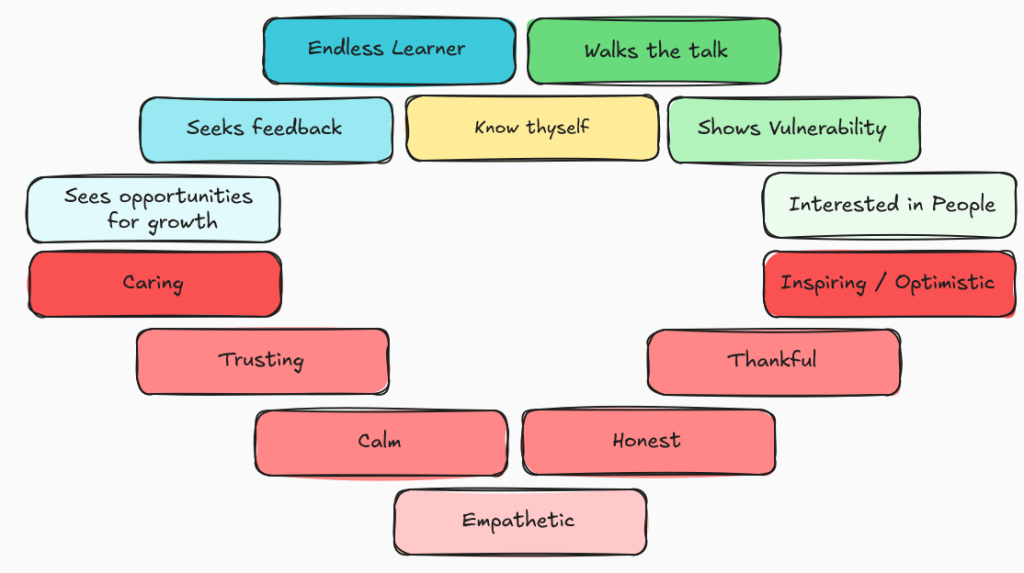
As Leaders, we’re frequently told that “Introspection is the key to figuring out how to lead”, yet no-one ever really shows you how to do that without falling into a pit of existential dread about your job. Linkedin is full of lunatics who genuinely claim that their marriage made them good salesmen, or their kid asking questions is what made them a good consultant. It’s content like that makes leadership laughed at as a subject of discussion in its own right.
Bottom line of leading well? You have to be really quite comfortable asking yourself very difficult questions, something we’re not designed to do from the ground up.
A question I always ask people when they start thinking about leadership is “How do you react when someone gives you the worst news imaginable to you?” – It’s not an easy one, because everyone’s ‘worst news’ is different.
My Brother died five years ago, that was the worst day of my life and it’s been a weird ride since. My Director at the time was fantastic, but I know there were other people who just ‘didn’t get it’ and were just awful about the entire situation.
How you respond to these situations forces that initial introspection. Take the above, how would you respond to me saying it?
- Do you respond with over-empathy and let the news ruin your entire day?
- Do you get upset yourself? Do you carry that with you all the way home?
- Do you respond with cold indifference?
- Do you guide me through what is ultimately, my pain?
- Do you head out for coffee and just listen?
Can you guess what answer I’d like you to have?
Depending on who you are, depending on what you’ve experienced, your mileage and response will vary depending on your level of self-reflection and confidence in yourself.
Self-reflection is great. I say this as a slightly-awkward, neurodivergent man who is partial to being painfully anxious when looking in the mirror… it’s great. Believe me.
I’ve journaled my entire adult life (Genuinely, there’s nearly 20 of them on my book shelves). Getting things, thoughts, situations and problems down in writing is a huge way to clear my brain at the end of the day. Each of the following questions are things I look at daily to see how to improve.
- How have I stood for my values today?
- Have I shown fear or poor judgment today?
- Have any situations triggered something in me to behave poorly?
- Has anything invoked my ire or frustrated me today?
- Have I shown my passion in the best way possible?
- Am I making strides towards my goals?
I don’t answer them all daily, just ones that I believe are relevant.
If I’ve had a rough day at the office, or it’s been an anniversary that I wasn’t looking forwards to? Then the entries change. But it always makes me assess myself impartially towards what behaviours I show (Which is important to me as a Neurodivergent man in this world.) There are more good days in my journal than there are bad, that’s probably something to be said about impartial reflection.
“What is important to me” is a huge bit of knowing yourself. “My kids”, “My family”, “My friends” are glib answers that are inoffensive and require little introspection. You’re biologically conditioned to want to keep those things important. Think bigger. Force yourself to think bigger. You owe it to yourself to do so.
- Is wisdom important? What wisdom? What areas do you wish to excel at?
- Is physical prowess important? Why? Do you enjoy it?
- How do you feel about politics / philosophy / economics? When did you construct that opinion?
- Why are my friends important? What do they bring me?
These are big questions, hard questions that are far more fun to ask oneself than “How was the weather today?” Ask yourself ‘why’ five times towards every part of your life, your opinions and your attitudes. Get yourself stuck in to the very fabric of what makes you who you are.
I’ve been asked a few times about my journey into leadership and as a person, I frequently joke with my wife that the man she married 5 years ago, is very different to the man I am now (Her response is always, “You were amazing then, you’re even better now.” I haven’t the time, nor words to articulate my entire journey here without disrupting the article. But between 2019 & 2021, a lot of things had changed beyond just a global pandemic.
But needless to say? Self-reflection, Counseling, Therapy, Philosophy all came rushing into my life to fill a void that my Brother’s passing left behind. It is what lead me to a path to want to make all people better, not just leaders.
If you don’t know how to self-reflect? That’s okay. It takes time and I encourage you to persevere with it.
Consider aking for feedback anonymously from peers and friends (the later is harder) as they’re the best to know you (That’s even part of the Human-Centric Framework!)
If the above doesn’t work? I highly recommend taking personality tests. They can be tedious, but very insightful to who you are as a person.
The importance of self-reflection, leads you to understand more and more who you are.
I’m seen a lot as the ‘life of the party’, ‘full of energy’ type of leader. It’s true, in many cases I’m the first to speak up, I’m the first to swear and probably the first to decry awfulness. But I’m also quite reserved, I keep to myself, I’m private and when I’m not having to put a public face on? Very quiet and broody (The long stare out of the window type) and will keep to myself.
I’ve spent a long time looking in the mirror and wanting to always be a better man for myself and others.
I know what makes me tick (Problems, Puzzles and People.)
I know what makes me knee-jerk or speak up (Injustice, Lack of integrity.)
I know what brings me joy (My wife, My dog, Archery, Motorbikes, Writing)
I know what my goals are (Philosophy, Weight training, …)
I know how I sound to others (My weird accent, my odd way with words)
The above sounds ridiculous, but I’m profoundly comfortable in my own skin. Something that means I can joke around to my own expense, let alone having banter with people. But also it gives me a confidence that let’s me lead people in a way that I’m not outwardly craving their opinion’s and feedback as a measure of my value.
I lead by knowing and being the man I am.
That leads to the problems with current leadership models. They focus on the idea that what happens in business is “cold”, “dispassionate” and “just business” when the reality is more often the opposite. There’s a reason we’re seeing huge burnout, managers getting called out and recently had Great Resignations / Quiet Quitting. It’s a meme unto itself that maybe an organisation doesn’t truly care, but the people inside it really do or at least should.
It doesn’t help that it’s trained into people from the ground up that ‘this is the natural order of things’ in business to be ruthless. It is such a ridiculous notion to think that organisations are ‘natural’ as opposed to the very man-made creations that they are. They CAN change, they SHOULD change, but they’re often designed in poor ways to make that very difficult.
Current Leadership training processes end up not preparing anyone to lead people, but rather to lead a business as if it’s a series of independent processes being run by equally interchangeable component parts. Rather than conforming processes being cranked by people of all shapes and sizes with different needs, wants and desires.
Subsequently there’s a raft of Leaders now talking about “People are the most important”, but it’s never really focused on YOU as a leader to want to make changes to yourself to be the best version of yourself. It’s always “Be better for people, so the business is better” rather than “Be better for yourself, so you can lead better, So the business is better.”
The problem being, one cannot truly succeed as a Leader in business without figuring themselves out AND being good for those beneath them.
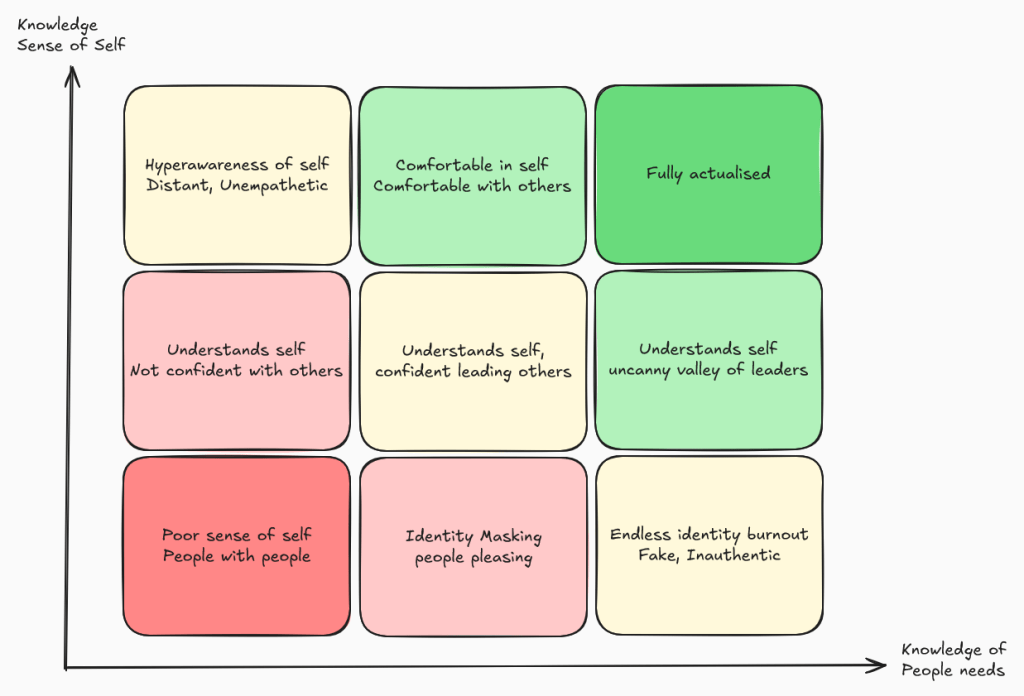
There’s a reason I’m always advocating that people do actually go speak to a therapist. You may not think you’ve got issues to resolve or things to learn about yourself, but you do.
Organisations can be cold and calculating, especially when you start entering senior leadership. Should they be?
Organisations can be dismissive of anything that doesn’t turn a profit / revenue. Should that be the way?
Organisations do believe it’s their employees place to try and change them (DE&I initiatives for example). Is that right? Or should leaders be better and make things more accessible?
In the face of changing needs of employees, the ‘cold hard facts of business’ type leaders are no longer needed, and any leader espousing that kind of mantra is both rejected and ridiculed.
When you’re a leader who’s stepping into teams who are demanding ever more accountability and ownership for the work they’re doing? You need to be more Teacher, Educator and Leader, rather than the Manager in a dark room.
But in order to do that, you’ve got to look at yourself in the mirror and know more about yourself than you ever thought you would.
 Human-Centric Leadership